



Chicken Run Strategy: An Expert Framework for Disciplined Play
Provider:
PoggiPlay
Type:
Crash
Volatility:
Medium
RTP:
95%
Minimum Bet:
0.1
Maximum Bet:
100
Autoplay:
No
Release Date:
28.05.2026
Players who approach Chicken Run with a structured framework consistently outperform those who rely on instinct — not because strategy alters the underlying 95% RTP, but because it enforces the discipline required to preserve bankroll across high-variance sessions. This guide presents the four-step gameplay protocol, the strategic logic behind each difficulty mode, three documented cash-out frameworks, and the bankroll principles experienced players apply.
The Four-Step Gameplay Protocol
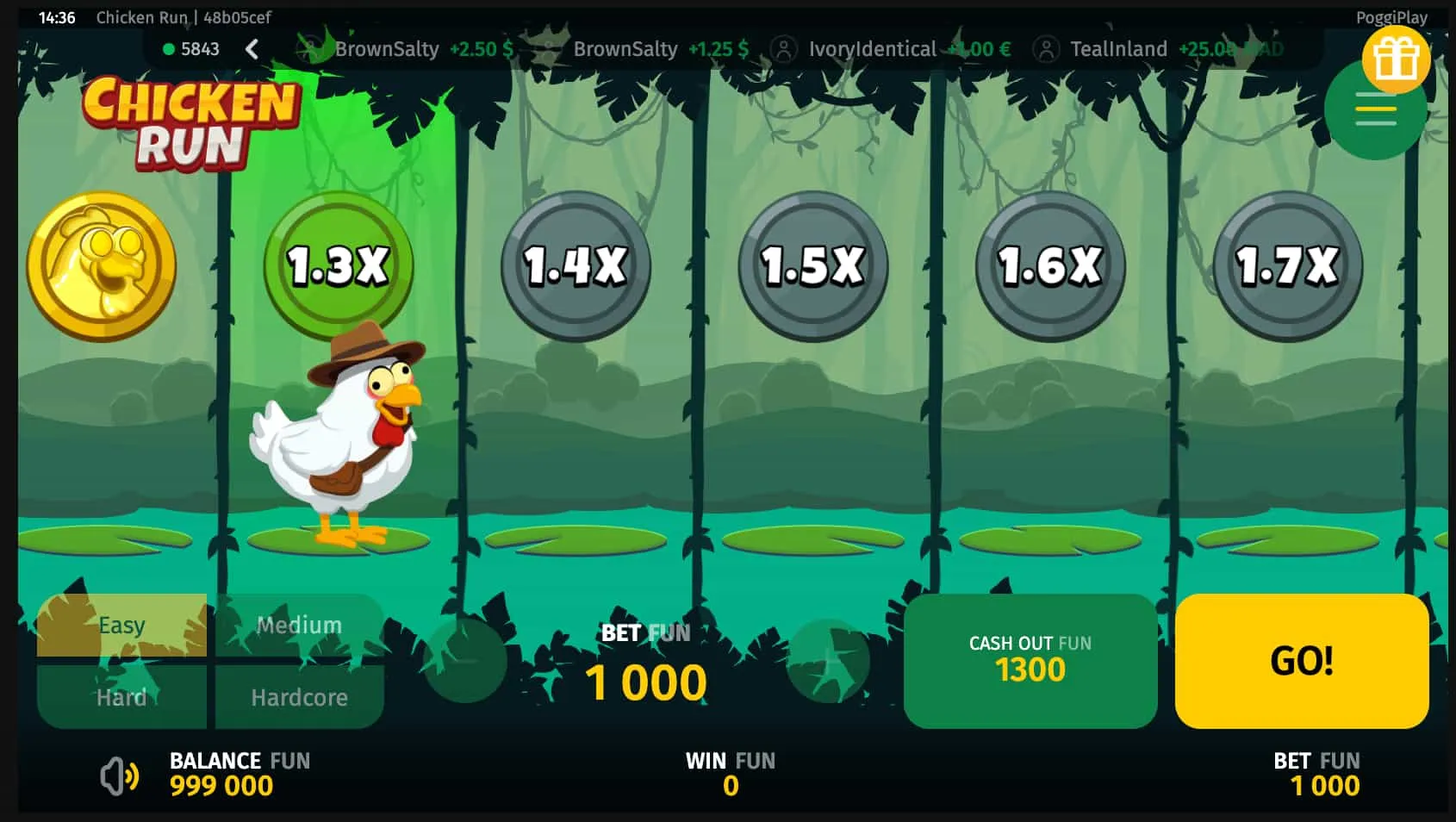
Every Chicken Run round follows the same sequence. Strategic value lies in the decision quality applied at each step, not the steps themselves.
Step 1: Difficulty Selection
The first action is selecting Easy, Medium, Hard, or Hardcore. This determines column count, starting multiplier, progression curve, and maximum achievable win. Expert guidance is unambiguous: Easy is the appropriate selection for early sessions; Hardcore is reserved for pre-committed high-variance bankroll allocations.
Step 2: Bet Placement
Bets range from £0.10 to £100 per round. The recommended bet sizing used by experienced players is 1–2% of session bankroll per round — a £50 session allocation translates to £0.50–£1.00 bets to allow sufficient round volume to absorb variance.
Step 3: Path Advancement
Pressing PLAY initiates the round. Each subsequent GO! advances the chicken one column. A successful advance applies the next multiplier. A crocodile ends the round immediately and forfeits the stake.
Step 4: The Cash-Out Decision
After each successful step, CASH OUT locks the current multiplier; GO! risks it for the next column. This is the strategic centre of the game and where the frameworks below intervene.
Selecting the Appropriate Difficulty Mode
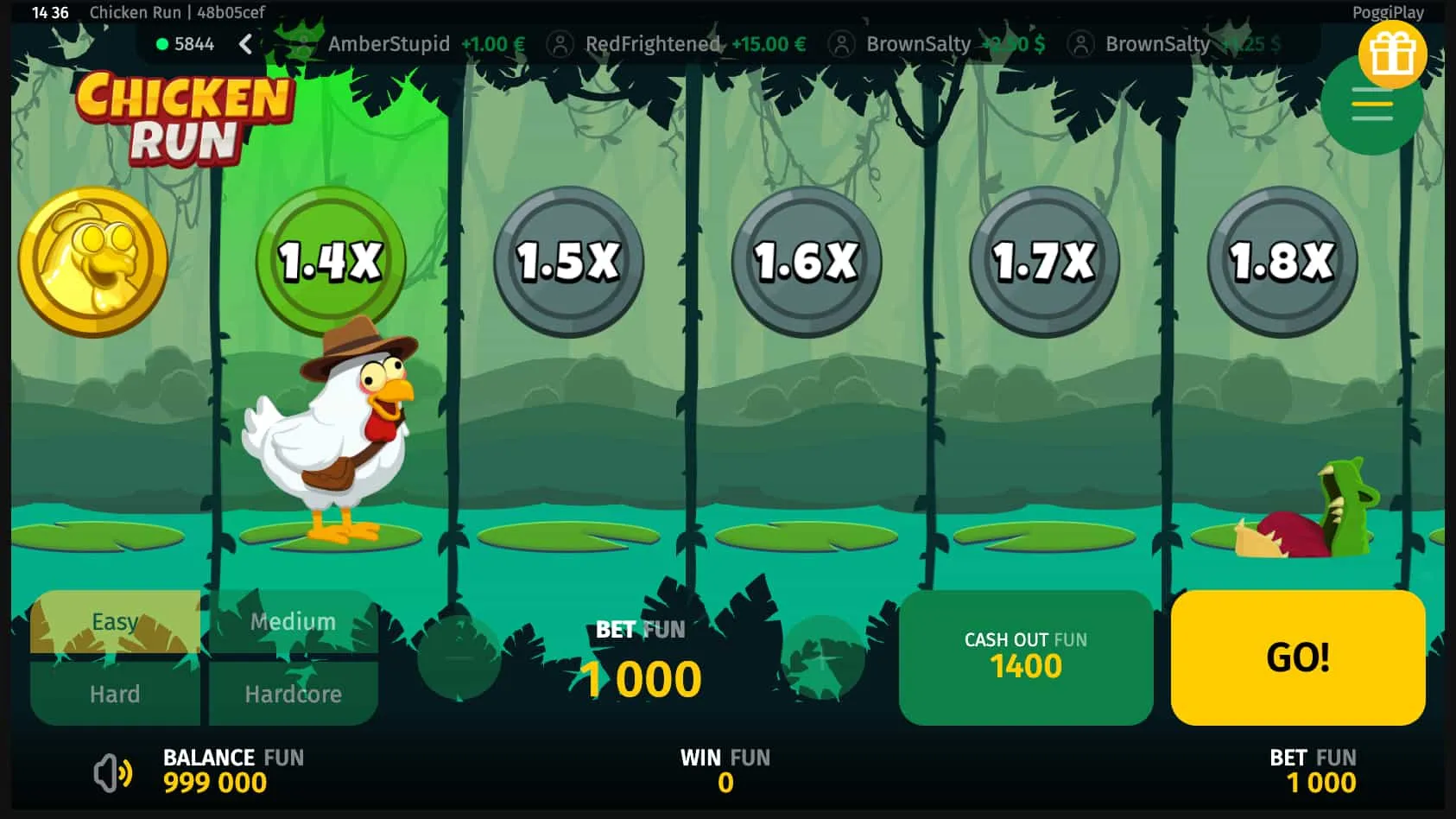
The four modes are structurally distinct configurations suited to different risk profiles, not ranked by quality.
| Mode | Columns | Start × | Max × | Suited To |
| Easy | 20 | 1.1× | 250× | New players; long sessions; calibration |
| Medium | 16 | 1.2× | 1,000× | Balanced risk-reward casual play |
| Hard | 12 | 1.4× | 2,000× | Experienced players; concentrated upside |
| Hardcore | 10 | 1.6× | 5,000× | Pre-allocated high-variance sessions only |
Independent analyst commentary characterises Hardcore as "designed for players who understand bankroll management" — not a default configuration. The 5,000× ceiling is achievable only in Hardcore by clearing all ten columns, a low-probability outcome by design.
Cash-Out Strategy Frameworks
None of the frameworks below alter the 95% theoretical RTP. What they do is enforce behavioural discipline that converts theoretical RTP into more consistent session outcomes by removing emotional decision-making at the critical point.
The Fixed-Target Method
The most disciplined framework: the player pre-defines a target multiplier (typically 3× to 5×) before each round and exits at that threshold regardless of momentum. Advantage: complete removal of in-round emotional input. Disadvantage: no upside capture when the chicken would have advanced further. Recommended for players prioritising bankroll preservation.
The Step-Ratio Method
A mathematically grounded variant: cash out after a defined number of successful steps regardless of multiplier value. Three to four steps on Easy or Medium; two steps on Hard or Hardcore. This framework adapts the exit point to the implied probability of failure at each step.
The Session Goal Method
A framework operating at session level rather than per-round. The player defines a profit target (e.g. +50% bankroll) and a loss limit (e.g. –30% bankroll), then plays until either threshold is reached. This method scales with bankroll size and integrates directly with UKGC-mandated deposit and loss limit tools.
The "Just One More" Trap to Avoid
The most common documented failure mode is the "almost-win" response — observing that the next lily pad would have been safe after a cash-out triggers a powerful pull to play another round. This is a behavioural phenomenon, not a mathematical one. The disciplined response: complete the originally planned session without extending round count or bet size.
Bankroll Management Principles
Chicken Run is a high-variance product, particularly in Hard and Hardcore configurations. The principles below apply to UK players subject to UKGC-mandated player protection requirements.
- Pre-session deposit limit: Configure the deposit limit at the casino before the session begins.
- Per-round bet sizing: Size bets at 1–2% of session bankroll to absorb variance.
- Loss limit threshold: Define a session loss limit at no more than 30% of session bankroll. Stop when hit, regardless of any sense that "the next round will recover it."
- Time discipline: Take a 10-minute break every 30 minutes of continuous play.
If gambling stops being entertainment, free and confidential support is available. GamCare helpline: 0808 8020 133 — 24/7. Additional resources: BeGambleAware.org and GAMSTOP.co.uk for national self-exclusion.
Applying the Framework
The recommended sequence is to test each cash-out method in demo mode across multiple difficulty configurations before committing real capital. The demo replicates the mechanics identically and provides the practical experience required to evaluate which framework aligns with individual risk preference. 18+ | Please gamble responsibly | BeGambleAware.org
Frequently Asked Questions
Is there a winning strategy for the Chicken Run game?
No strategy alters the 95% theoretical RTP — that is a structural property of the title. What strategy can do is enforce behavioural discipline that translates theoretical RTP into more consistent session outcomes by removing emotional decision-making at critical points.
Which difficulty level offers the best chance of winning?
Easy mode offers the highest probability of reaching a positive cash-out per round due to its 20-column path and gradual multiplier progression. Hardcore offers the highest theoretical maximum at 5,000× but the lowest probability of clearing the path. The "best" mode depends on whether the objective is bankroll preservation or chasing the maximum-variance payout.
When is the optimal moment to cash out?
The optimal cash-out point is the one defined before the round begins, not the one that feels right mid-round. Documented frameworks include fixed multiplier targets (3×–5×), fixed step counts (3–4 on Easy/Medium; 2 on Hard/Hardcore), and session-level profit targets. The common factor is removal of in-round emotional input.